- /
-
- Blog /
- BLE WCH chips
BLE WCH chips
Wireless options from Nanjing Qinheng Microelectronics (4 minutes read)
2025-08-02
Introduction
I was looking for some BLE-enabled WCH chips which would be cheap, and possibly hand-solderable (if having a QFN package, then one with fewer pins). So I made a small summary blog post about their chips to act as a reference. My preference for packages:
- Low-Profile Quad Flat Package LQFP (more pins, more SoC features than *SOP packages).
- Shrink small-outline package SSOP (a bigger variant of TSSOP).
- Exposed Pad Shrink Small Outline Package ESSOP (SSOP with a thermal pad exposed on the bottom).
- Thin small-outline package TSOP.
- Quad-flat no-leads QFN. I struggle with these without at least one of the following: hot-air, hot-plate, solder-mask. I usually have all 3, but not always by hand, and paying for solder masks or having a dedicated QFN mask for various sizes is not always practical. Solder mask requires good (not expired) solder paste. So when I do not do QFNs in bulk, I prefer to avoid them as much as possible.
BLE
The low-energy revision of Bluetooth is very suitable for battery-powered embedded devices, significantly different and not backwards compatible with classic Bluetooth. BLE is a family of its own dedicated PHYs, profiles, protocols, and codecs.
WCH chips
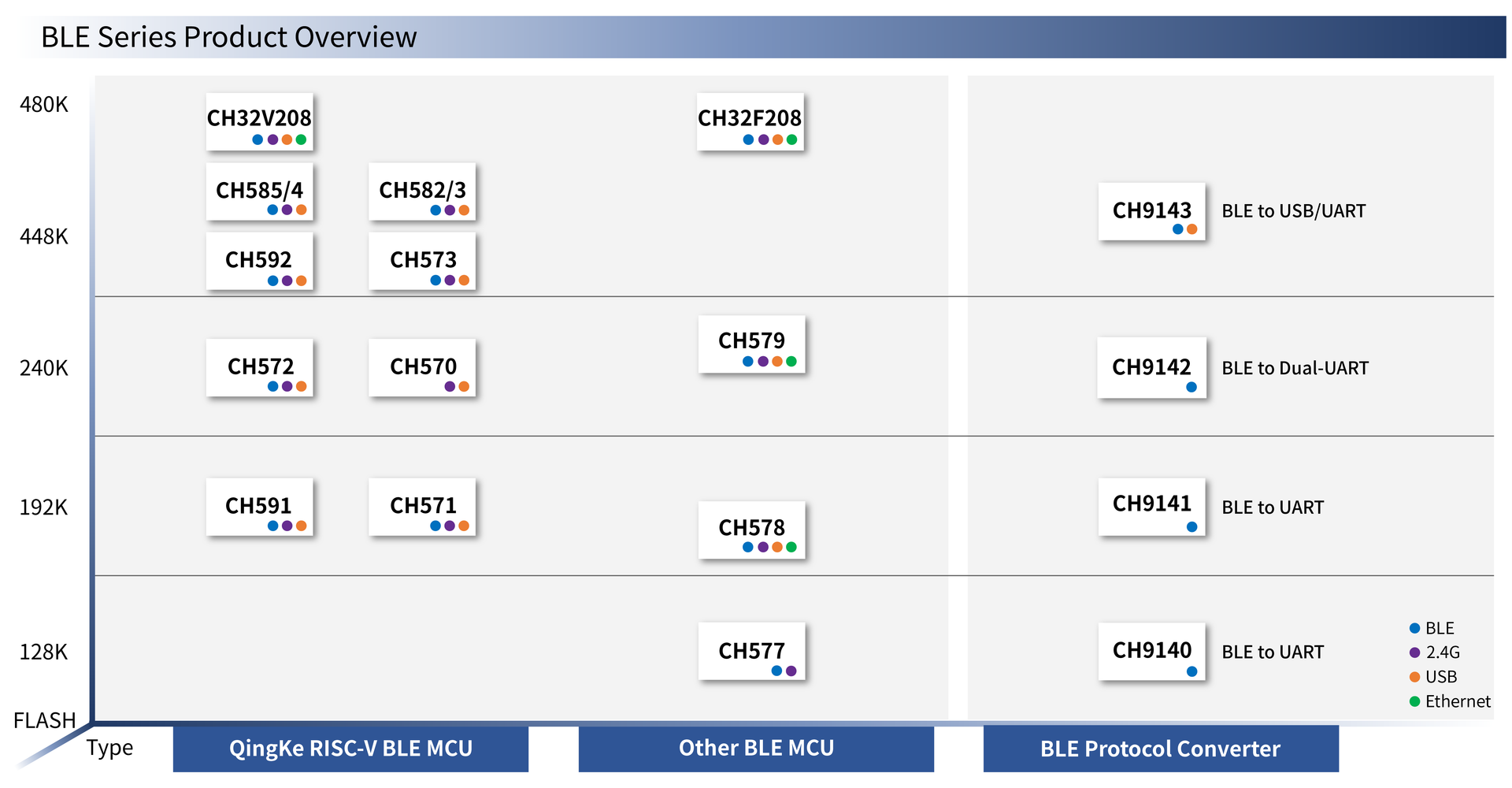
These have some wireless capability, with links to some of their listings on AliExpress. Packages highlighted in bold are my preferred ones for that part. Ordered by their BLE version (and then by their FLASH size):
| Part | Freq | Flash | SRAM | BLE | VDD | Packages | Notes |
|---|---|---|---|---|---|---|---|
| CH585 | 78MHz | 448K | 128K | 5.4 | 1.75/3.3 | QFN48/QFN32/QFN26C3/QFN20 | |
| CH584 | 78MHz | 448K | 96K | 5.4 | 1.75/3.3 | QFN48T/QFN32 | |
| CH592 | 20MHz | 448K | 26K | 5.4 | 1.75/3.3 | QFN32/QFN28 | 3.3euro dev board and 70cent QFN28 |
| CH591 | 20MHz | 192K | 26K | 5.4 | 2.3/3.3 | QFN28/QFN20/TSSOP16 | 70cent TSSOP16 |
| CH583 | 20MHz | 448K | 32K | 5.3 | 1.75/3.3 | QFN48 | |
| CH582 | 20MHz | 448K | 32K | 5.3 | 2.3/3.3 | QFN48/QFN28 | 2.6euro dev board |
| CH32V208GBU6 | 144MHz | 128K | 64K | 5.3 | 2.5/3.3 | QFN28 | |
| CH32V208CBU6 | 144MHz | 128K | 64K | 5.3 | 2.5/3.3 | QFN48 | |
| CH32V208RBT6 | 144MHz | 128K | 64K | 5.3 | 2.5/3.3 | LQFP64M | 8euro dev board |
| CH32V208WBU6 | 144MHz | 128K | 64K | 5.3 | 2.5/3.3 | QFN68 | |
| CH572 | 100MHz | 240K | 12K | 5.0 | 2.0/3.3 or 4.5/5.0 | QFN20/DFN10X3/TSSOP16 | 41cent QFN20 |
| CH573 | 20MHz | 448K | 18K | 4.2 | 1.75/3.3 | QFN28 | 7.6euro dev board |
| CH571 | 20MHz | 192K | 18K | 4.2 | 2.3/3.3 | QFN28/TSSOP16/ESSOP10 | 50cent ESSOP10 |
| CH570 | 100MHz | 240K | 12K | Wireless | 2.0/3.3 or 4.5/5.0 | QFN20/DFN10X3/SOP8 | Not WiFi, Not Bluetooth. 9.0 dev board and 29cent QFN20 |
BLE versions
But what are the differences between these versions, and what features do they provide?
| Version | Max range | LE PHYs | Notes |
|---|---|---|---|
| 4.0 | ~50 m | 1M | First BLE version |
| 4.1 | ~50 m | 1M | Minor improvements (Version my Canon 90D supports) |
| 4.2 | ~50 m | 1M | Better security & throughput & slight efficiency gains (all WCH) |
| 5.0 | ~240 m | 1M, 2M, Coded | Introduced Long Range mode (LE Coded PHY) |
| 5.1 | ~240 m | 1M, 2M, Coded | Direction finding |
| 5.2 | ~240 m | 1M, 2M, Coded | LE Audio (LC3, multi-stream, Auracast) & basic power control |
| 5.3 | ~240 m | 1M, 2M, Coded | Better power control & efficiency |
| 5.4 | ~240 m | 1M, 2M, Coded | Electronic Shelf Label & Periodic Advertising with Responses |
The newer BLE versions are backwards compatible with older BLE devices.
Low energy physical layer (LE PHY)
PHYs dictate the range and data rates. Some BLE versions can switch between multiple PHY variants (but obviously only one at a time).
| PHY | Raw Data Rate | Estimated range |
|---|---|---|
| LE 1M | 1 Mbps | 10 - 30m |
| LE 2M | 2 Mbps | 10 - 50m |
| LE Coded (S=2) | 500 kbps | 30 - 100m |
| LE Coded (S=8) | 125 kbps | 50 - 150m |
For example, BLE 5.4 can operate from 1 Mbps data rate and up to 30m range, to 125 kbps data rate and up to 150m range, allowing the user to select the compromise between speed, range and power consumption. Theoretically, the fastest PHY should be the most efficient. It takes the least amount of time to transfer the same amount of data and spends more time powered down compared to slower PHYs. For example, LE Coded (S=8) is not just slower. It actually transmits at LE 1M speed but allocates 8x more data to redundancy and expected packet loss. So even if the effective data rate is not high, the raw data rate is still pretty high.
Conclusion
There is no conclusion, each chip provides slightly different features and everybody needs to make their decision for their application.
References
- Bluetooth Low Energy BLE Wikipedia
- WCH RISC-V Bluetooth wireless product family
- AliExpress WCH store
- WeAct have interesting boards: